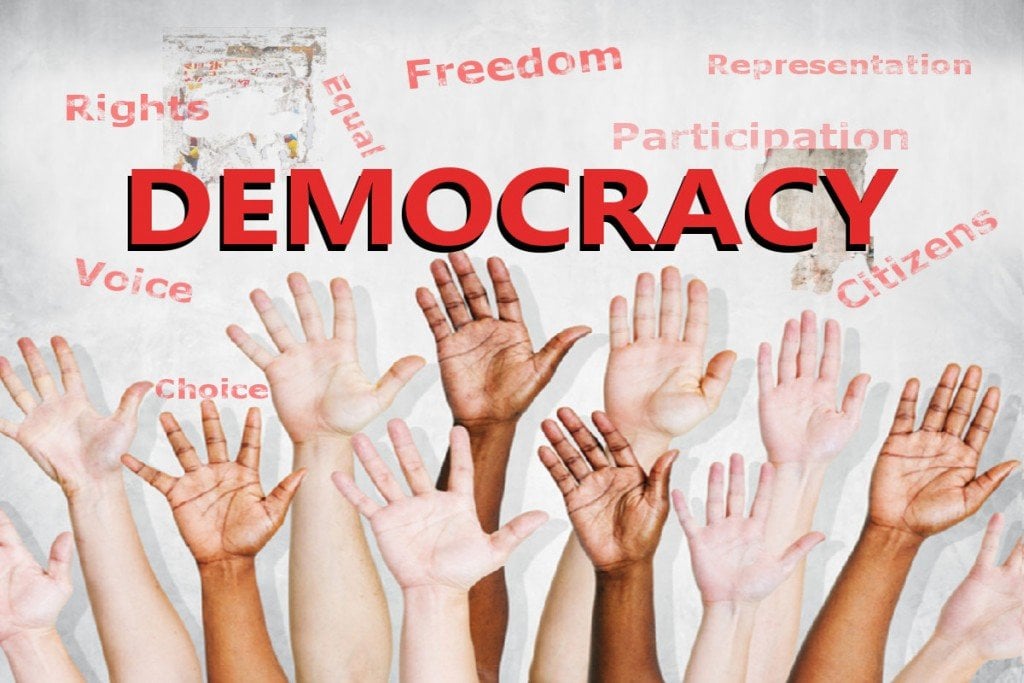
Topics covered.
- Main features of democracy
- Principles of democracy
- Types of democracy
- Type of democracy in India
A system of government by the whole population or all the eligible members of a state, typically through elected representatives.
Main features of democracy.
- In democracy representatives elected by the people make laws and frame policies of the government.
- All adult citizens above the age of 18 yrs have the right to vote in the elections.
- All citizens irrespective of caste, creed, religion, race or sex are considered to be equal before law and enjoy equal political rights.
- Democracy provides the individual dignity by giving various rights to the individual.
- Democracy is characterized by independent judiciary.
- Presence of organized opposition party or parties.
- Democracy implies free and open society.
Principles of democracy.
- Popular Sovereignty.
- Limited Government.
- Separation of Powers.
- Checks and Balances.
- Judicial Review.
- Federalism.
Types of democracy.
- Direct democracy.
- Representative democracy.
- Presidential democracy.
- Parliamentary democracy.
- Authoritarian democracy.
- Participatory democracy.
- Islamic democracy.
- Social democracy.
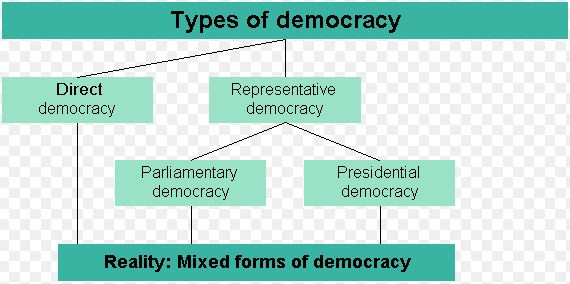
What type of democracy exist in India??
Indirect democracy, or representative democracy, is when citizens elect representatives to make laws for them.
In many representative democracies(USA,Canada,India,etc.) representatives are chosen in elections . Elections may be won by plurality or majority or some other way. In theory other methods, such as allotment (selection by a lottery) could be used instead. Also, representatives sometimes hold the power to select other representatives,presidents, or other officers of government (indirect representation).
Indian Constitution a federal??
The Constitution of India established a federal system of government. It contains all the usual features of a federation, viz., two government , division of powers, written Constitution, etc. However, the Indian Constitution also contains a large number of unitary or non-federal features, viz., a strong Centre, single Constitution, single citizenship, the flexibility of Constitution, and so on. Hence, the Indian Constitution has been variously described as ‘federal in form but unitary in spirit’, ‘quasi-federal’ by K.C. Wheare , ‘bargaining federalism’ by Morris Jones, ‘co-operative federalism’ by Granville Austin, ‘federation with a centralizing tendency’ by Ivor Jennings, and so on.
Questions??
- Which is the most common of democracy in the world?
- Name the characteristics of democracy.
- Democracy as an evolution , explain
- In democracy, majority of people rule through their representatives. Give reasons
- How does democracy in a country enhance the dignity of people?
- What is the difference between democracy and dictatorship?
 CommuneAcademia